
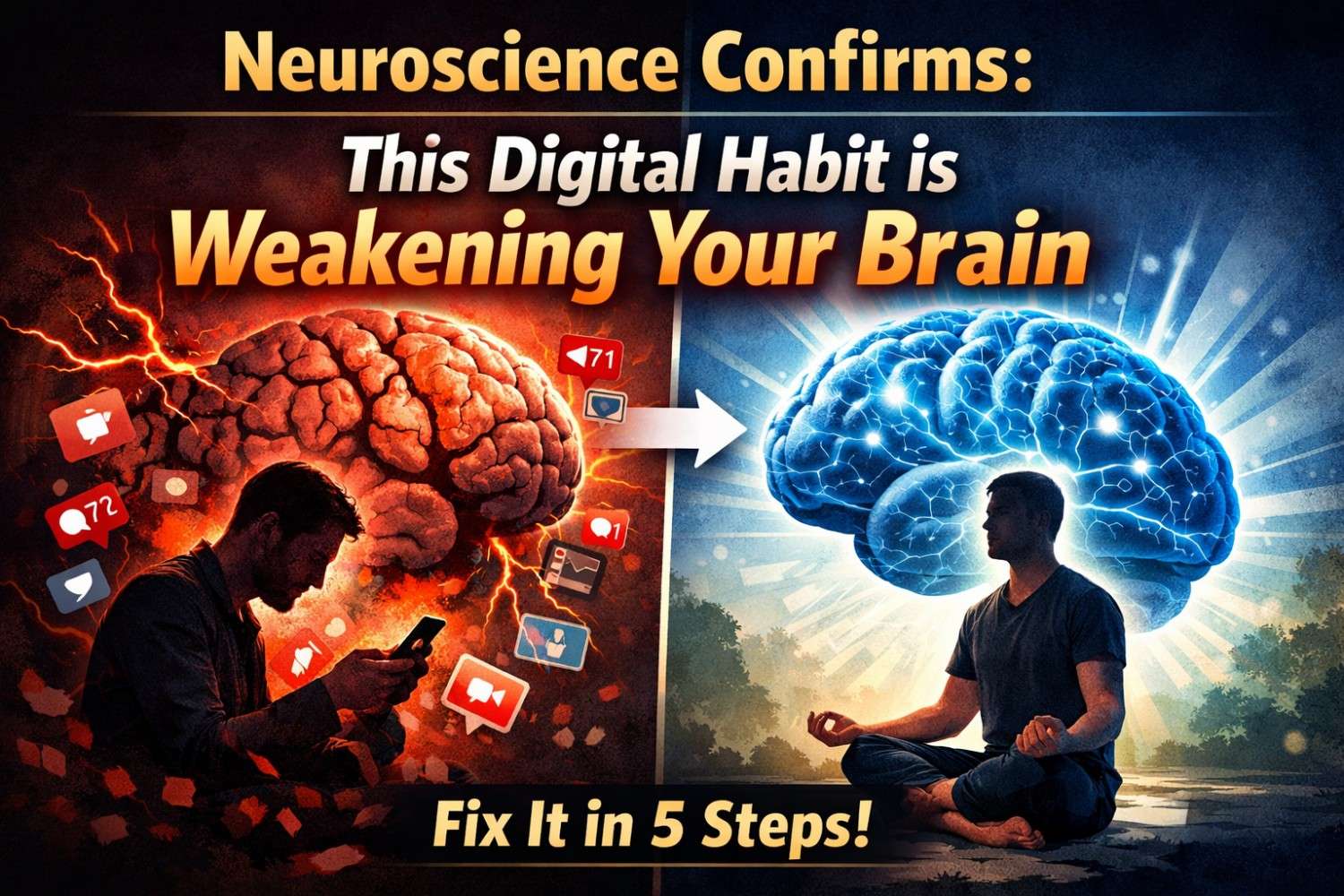
Have you felt more distracted lately? Do you feel overwhelmed by simple tasks, or find yourself mentally exhausted by 2:00 PM?If you’re nodding your head, you aren't alone. And more importantly, you aren't "losing it."
According to Dr. Matt Jones, a physician and expert in cognitive performance, this isn't necessarily a result of aging or a personal lack of discipline. It is a physiological response to a specific habit that almost all of us engage in daily: problematic digital behavior.
We aren't just talking about "screen time." We are talking about the way we use screens—specifically doom scrolling, app hopping, and rapid-fire short-form content. Here is the science of what is happening to your brain and the exact protocol to fix it.The Problem: It’s Not Just "Screens," It’s the "Micro-Switching"
For years, we heard warnings that phones would "rot our brains." It turns out, the critics were onto something.The issue isn't just looking at a screen; it is the constant novelty and micro-switching. When you scroll through social media, you are exposing your brain to a "dopamine drip of tiny unintentional scrolls" combined with drastic emotional swings. You might see a funny cat video, followed immediately by a tragic news headline, followed by an advertisement.
This trains your brain to crave stimulation rather than focus. The Neuroscience: Shrinking Gray Matter. This digital habit is doing more than just wasting your time; it is causing physical changes in your brain structure.
Recent imaging studies have shown consistent gray matter reductions in two critical areas of the brain:
1. The Dorsolateral Prefrontal Cortex: Responsible for top-down control and focus.
2. The Anterior Cingulate Cortex: Responsible for emotional regulation and decision-making.
Furthermore, EEG studies suggest that people addicted to short-form video exhibit weaker "frontal theta power," which is essentially the brain's capacity for deep thinking. A large longitudinal study even found that high internet use predicted smaller gains in verbal intelligence over time. In simple terms: You aren't getting dumber, but your brain is being trained in the wrong direction. You are running on hardware that is overstimulated and undertrained.
The Symptoms: The "Put a Finger Down" Test
How do you know if your gray matter is taking a hit? Dr. Jones suggests a quick self-assessment. If three or more of these resonate with you, your cognitive capacity is likely compromised:
• You can’t read more than 1–2 pages of a book without reaching for your phone.
• You lose your train of thought mid-sentence.
• You open your phone to do one specific thing, but do five other things instead.
• You feel mentally tired after tasks that should be easy.
• You bounce between browser tabs with no plan.
The Solution: How to Rebuild Your Brain
The good news is that the brain is plastic. These changes are reversible. You don't have a motivation problem; you have an overstimulation problem.
Here is the 5-step protocol to reclaim your focus:
1. "Deep Work" Interval Training Don't try to go "monk mode" for 3 hours immediately. Your brain is out of shape. Start with short "reps" of 10 to 30 minutes. Pick one task, turn off all notifications, and do not switch tasks. Use a timer (like the Pomodoro technique). Over time, your brain will re-learn how to sustain depth.
2. Dual N-Back Training (Mental Weights) This is one of the only cognitive training methods shown in research to reliably improve working memory. It is a game you can play on your phone or computer for 15–20 minutes.
• Warning: It is difficult and boring ("It sucks," as Dr. Jones admits). But doing it daily acts as weightlifting for your working memory, sharpening your problem-solving and emotional regulation.
3. No-Scroll Mornings If you give your attention away to your phone first thing in the morning, your brain will spend the rest of the day trying to get it back. Implement a strict rule: No scrolling and no short-form content before your first block of deep work. Let your mind settle into its baseline before hitting it with dopamine.
4. Introduce Friction (NFC Blockers) Willpower often fails against the unconscious reflex to check apps. Dr. Jones recommends using physical friction, such as NFC tags (like the brand "Brick"). You tap your phone to a physical tag (left in another room) to lock your distracting apps. This breaks the unconscious habit loop.
5. Attention Recovery Windows You need to reset your cognitive fatigue. Schedule one or two blocks (30–60 minutes) a day where you do nothing stimulating.
• Go for a walk without a podcast.
• Sit quietly.
• Read a physical book. This "re-sensitizes" your attention and calms the nervous system.
The 7-Day Challenge
Ready to start? Try this for just one week to feel a difference in your mental clarity:
1. Morning: No scrolling for the first hour of the day.
2. Daily: One 10–30 minute "Deep Work" session (no multitasking).
3. Every Other Day: 10–15 minutes of Dual N-Back training.
Your brain is incredibly adaptive. Treat it well, and it will return the favor.
This writing is based on Dr. Matt Jones video.
Video Link: Neuroscience Confirms: This Daily Habit Is Destroying Your Focus
Discussion (0)
No comments yet. Be the first to share your thoughts!