
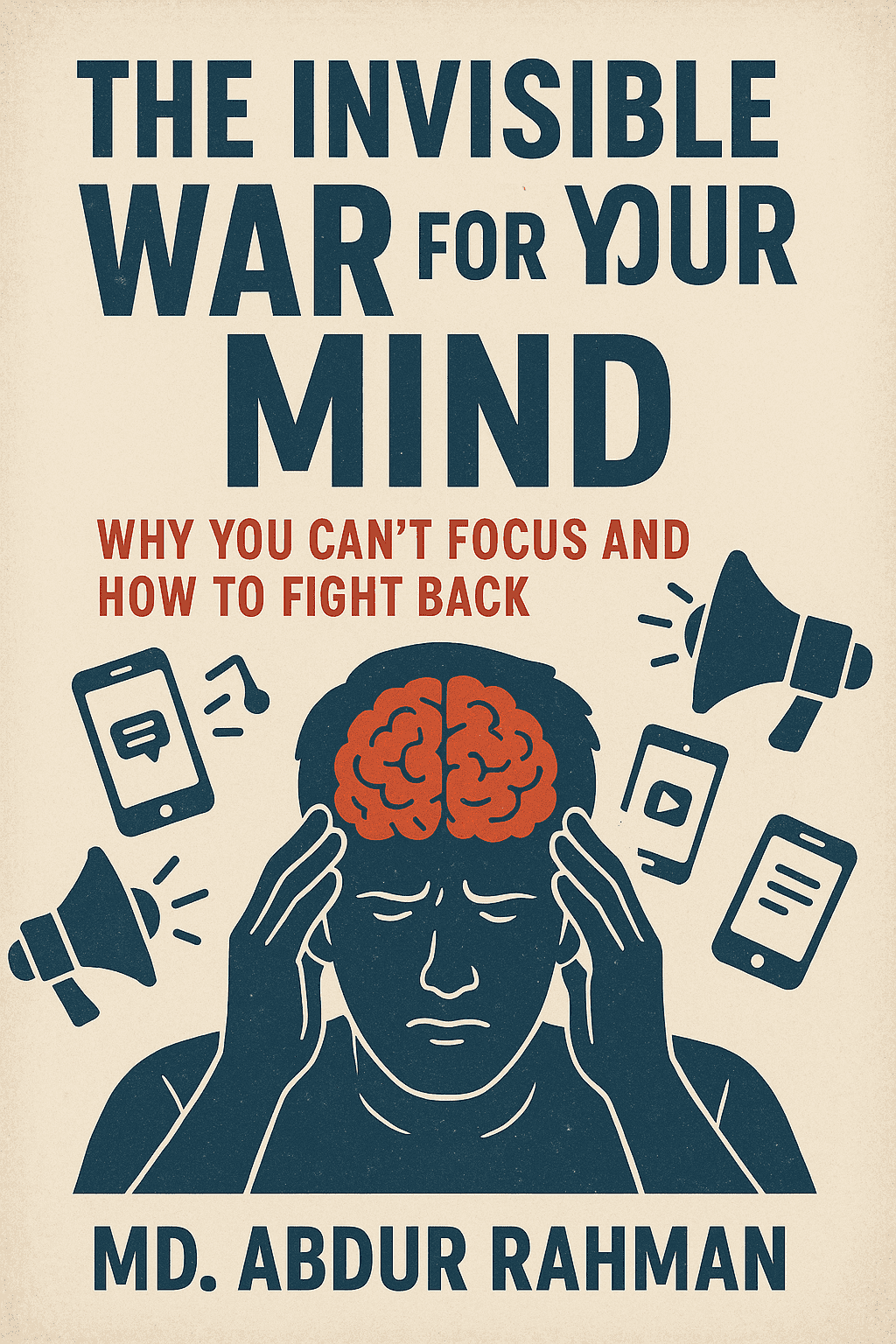
Have you noticed lately that you can’t seem to remember names, finish a book, or even sit through a full lecture? Do you find that small joys don’t satisfy you anymore, and you constantly feel the urge to check your phone?
If so, you are not alone. You are a victim of an "invisible war" being fought against you by some of the smartest people on earth. The target? Your most valuable resource: Your Attention.
Here is a breakdown of why this is happening, what it’s doing to us, and how we can reclaim our lives.
The Cause: Engineered Addiction
It is not an accident that we are addicted to our screens. It is a carefully calculated design.
• The Psychology of Color: Have you noticed that Facebook, LinkedIn, Twitter, and Skype all use shades of blue? Or that notifications are almost always red? These colors aren't random. Tech giants hire neuroscientists to determine exactly which colors trigger arousal and excitement. For example, Google once increased its yearly revenue by $200 million just by testing 41 different shades of blue to see which one generated the most clicks.
• The Novelty Trap: Social media platforms utilize the "News Feed" model, which allows for infinite scrolling. This works on the same psychology as FM radio replacing MP3s; the uncertainty of "what comes next" creates a Novelty Bias. Our brains are wired to be curious about new things, and these platforms exploit that to keep us hooked.
• The Objective: As Facebook’s founding president Sean Parker admitted, the goal of these platforms is to capture as much of your conscious attention and time as possible. In today’s economy, attention is the ultimate currency. If they control your attention, they influence what you buy and how you behave.
The Effect: The Rise of the "Zombie" Mind
The consequences of this war for attention are severe. We are shifting from having a "Typographic Mind"—one capable of deep, linear thought developed by reading—to a distracted state where we are "Amusing Ourselves to Death".
• Cognitive Decline: We are slowly becoming like "zombies"—walking around with reduced memory, reasoning capabilities, and cognitive capacity.
• Shattered Focus: Our average attention span has plummeted from 2.5 minutes in 2004 to just 50 seconds in 2023. Even having a phone on the table, even if ignored, reduces your focus because your brain has to actively decide to ignore it, leaving "attention residue" that hurts your performance.
• Induced ADHD: High-frequency digital media use is creating ADHD-like symptoms even in people who were not previously diagnosed with the condition.
• Loss of Happiness: We often think wealth or pleasure brings happiness, but studies show the happiness gap between the rich and the poor is surprisingly small. True happiness comes from "Flow"—a state of deep, focused engagement in meaningful work. Because our attention is constantly fractured, we can no longer enter this state, leaving us feeling unfulfilled.
The Solution: Deep Work and Flow
The good news is that we can fight back. To reclaim our happiness and success in an age of AI and distraction, we need to master the art of Deep Work and enter the Flow State.
1. Understand the Formula for Success According to Cal Newport, author of Deep Work, surviving in the machine age requires mastering complex skills quickly and producing elite-level output. The formula is simple:
High-Quality Work = Time Spent × Intensity of Focus
2. Follow a High-Performance Protocol To achieve this intensity, you cannot just "try harder." You need a structured system, divided into three phases:
• Phase 1: Preparation: Before you start working, design your environment. Block your time, remove your phone (the biggest enemy), and adjust the lighting and temperature. Set a clear intention and "finish line" for the session.
• Phase 2: Performance: Use "activation rituals" (like breathing exercises or visualization) to signal your brain it is time to focus. Structure your work sessions and, crucially, know what not to do during breaks (avoid social media) to keep your energy high.
• Phase 3: Preservation: Don't just walk away when finished. Review your work, plan the next session, and close the loop properly to avoid carrying mental clutter into the rest of your day.
Final Thoughts
The tech moguls who built these addictive systems—like Steve Jobs and Mark Zuckerberg—are famous for restricting their own children's access to technology. They know the danger.
We must be just as vigilant. By designing our environment and prioritizing Deep Work, we can protect our minds, regain our ability to focus, and rediscover the happiness that comes from truly meaningful engagement
Discussion (1)
Nice and Important blog. Very helpful.